
Safe Schools
ECLEF leverages its partnerships with law enforcement agencies and numerous other businesses and organizations to present the Safe Schools Initiative Seminar
The 22nd Annual Seminar took place on Wednesday, March 18, 2026
8:30am - 12:30pm EST
UB CENTER FOR THE ARTS
From Threat Assessment to Digital Tech:
Protecting Students in a Changing World
RESOURCES
1st Presentation:
Social Media, AI, Technology, and Adolescent Mental Health
PRESENTERS
Mitch Prinstein
Senior Science Advisor of the American Psychological Association
John Van Seters Distinguished Professor of Psychology and Neuroscience, University of North Carolina at Chapel Hill (UNC)
Co-Director of the UNC Winston Center on Technology and Brain Development
Eva Telzer
UNC Professor of Psychology and Neuroscience
Co-Director of the UNC Winston Center on Technology and Brain Development
Associate Editor at Child Development and Social Cognitive and Affective Neuroscience
2nd Presentation:
Understanding the Threat Landscape Preceding Mass Public Shootings
PRESENTERS
Jaclyn Schildkraut
Executive Director, Regional Gun Violence Research Consortium, Rockefeller Institute of Government
Emily Greene-Colozzi
Assistant Professor, School of Criminology and Justice Studies, University of Massachusetts Lowell
Project Associate, The American School Shooting Study (TASSS), John Jay College of Criminal Justice, Michigan State University, University of South Carolina
Project Associate, The Extremist Cybercrime Database (ECCD), John Jay College of Criminal Justice, Michigan State University
Sponsor & Exhibitor Links for Schools Safety
1. Better Business Bureau (BBB) of Upstate NY Student Scam and Fraud Prevention
2. Compeer Buffalo: School-Based Mentoring Program
3. Crisis Leadership Preparedness Solutions (CLPS): Threat Assessment HPMT CLPS for NY Schools Partnership with Utica National Insurance Group
4. Department of Homeland Security (DHS) know2protect - Project iGuardian @ongoing threats to children and teens from online predators
5. FBI: FBI Preventing Financial Sextortion; PSA’s: The Com, Hacker Com, In Real Life (IRL) Com, Violent Online Networks Targeting Vulnerable and Underage Populations
6. National Alliance on Mental Health (NAMI) of Buffalo & WNY: Child & Youth Treatment
7. National Center for Missing & Exploited Children (NCMEC): Training for Public Safety and Child-Serving Professionals
8. UB Alberti Center for Bullying Abuse Prevention Resources Page Band Against Bullying
9. UB Department of Industrial and Systems Engineering: Resource allocation in multi-layer, continuous defense, security games versus strategic attackers Game-Theoretic Optimization on School Safety: Resource Allocation Against Strategic Attacks
10. USSS (& NTAC): visit https://www.secretservice.gov/protection/ntac for more Guidance for Law Enforcement and School/Campus Attacks
11. Utica National Insurance Group: Tips on Educational Institutions Safety & Loss Prevention
12. WNY Regional Information Center (WNYRIC) Raptor School Emergency Management Brochure
2026 Seminar Sponsors
Partner Sponsors

Stakeholder Sponsors
David Zebro
Benefactor Sponsors
Kevin Clarke * Patrick P. Lee


Barbara & David Elias
Community Sponsors
Michael Brummer
Myszka Family Foundation
NYS Leadership Group, LLC
Founding Sponsors
Planning Partners & Sponsors
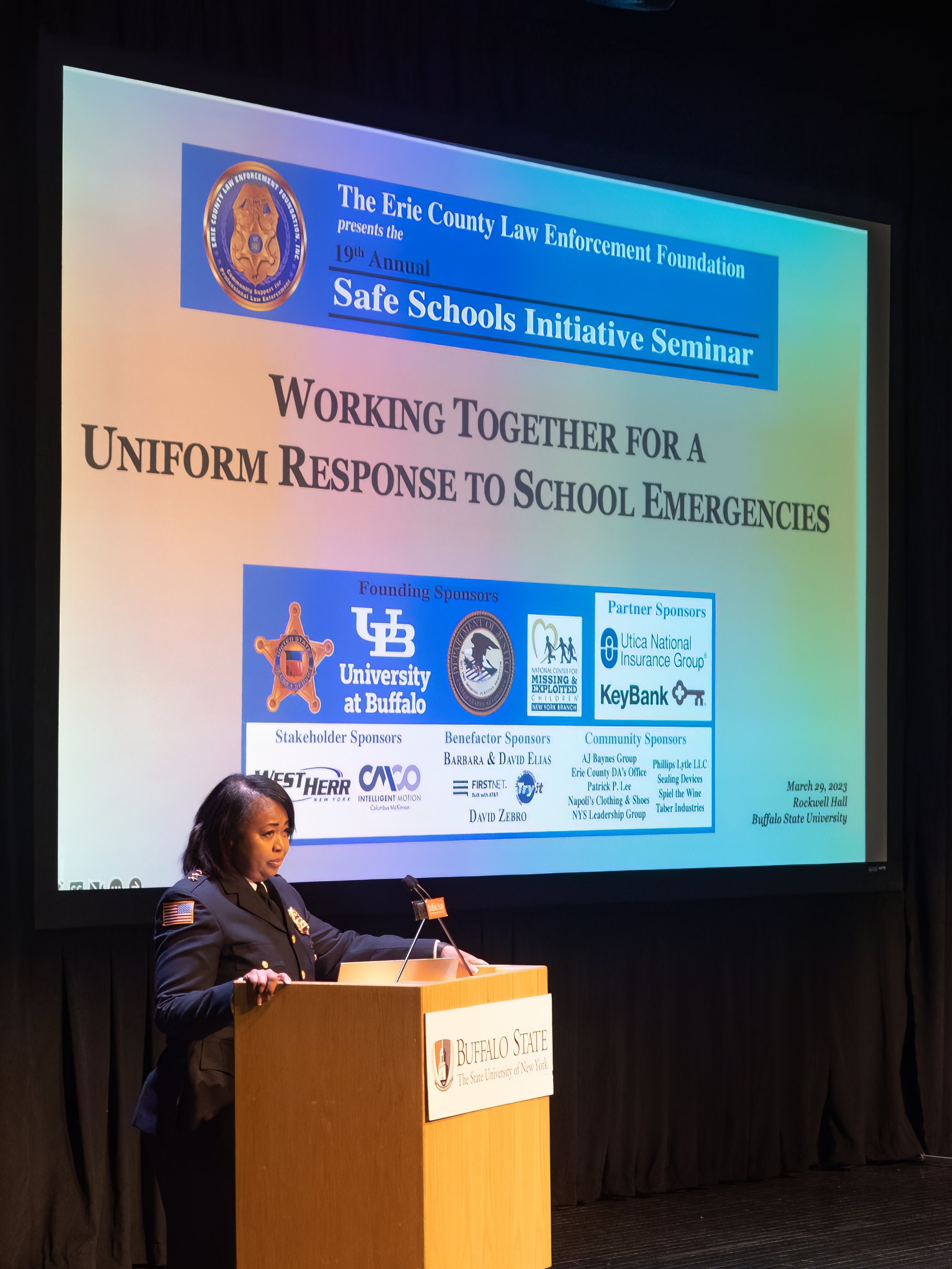
As the Presenting Sponsor, the Erie County Law Enforcement Foundation (ECLEF) is most fortunate to have the long-standing planning and management support of the seminar’s Founding Sponsors: the U.S. Secret Service, Buffalo Field Office; the University at Buffalo’s Alberti Center for Bullying Abuse Prevention; the U.S. Attorney’s Office, Western District of New York; and the National Center for Missing and Exploited Children (NCMEC), New York Office.
The seminars have all been led by nationally recognized leaders, and have benefitted from the regular participation of the USSS National Threat Assessment Center, the Department of Homeland Security and the FBI among other law enforcement agencies.
Offering this seminar for free would not be possible without the year-to-year financial support of multiple sponsors. Together with the commitments from our Founding Sponsors, the program benefits tremendously from the long-term collaboration and financial assistance - since 2009 - of Partner Sponsor Utica National Insurance Group, along with a host of other dedicated sponsors who recognize the value of providing essential & timely programming to our stakeholders in school safety.
Planning Committee
John Acee, AU
Educational Institution Segment Specialist, Utica National Insurance
Robert Christmann
Executive Director, NYS Leadership Group at Buffalo State University
Kevin Clarke
ECLEF Board Member
David Elias
ECLEF Board Member
Tom Kelly
Captain, NYS Troopers, retired (former SRO)
Brie Kishel
Program & Operations Manager, Alberti Center for Bullying Abuse Prevention, University at Buffalo
Natalie Lesh
Special Assistant/Conviction Integrity/Community Prosecution, Erie County District Attorney’s Office
Kristen Mruk
Lecturer in Higher Education Administration and Special Assistant to the Provost & Senate, Buffalo State University
Amanda Nickerson
SUNY Distinguished Professor & Director, Alberti Center for Bullying Abuse Prevention, University at Buffalo
Samuel Palmiere
BBB of WNY; former Law Enfocement Coordinator for the US Attorney's Office, Western District of NY; ECLEF Board Member & Past Chair
Charles Perras
Special Agent in Charge, Buffalo Field Office
US Secret Service
William Regan
Seminar Coordinator; ECLEF Chair
Edward Suk
Executive Director, National Center for Missing & Exploited Children/New York